Faster Wet-Out. Consistent Grind. Built for Production.
High Speed Dispersers for Every Batch, Tank and Formula
Heavy-duty high speed dispersers for paint and coatings plants, ink makers, adhesive and sealant producers, and pigment and chemical processors. They pull powder into the batch quickly and give the same grind from one batch to the next, on a lab bench or over a production tank.
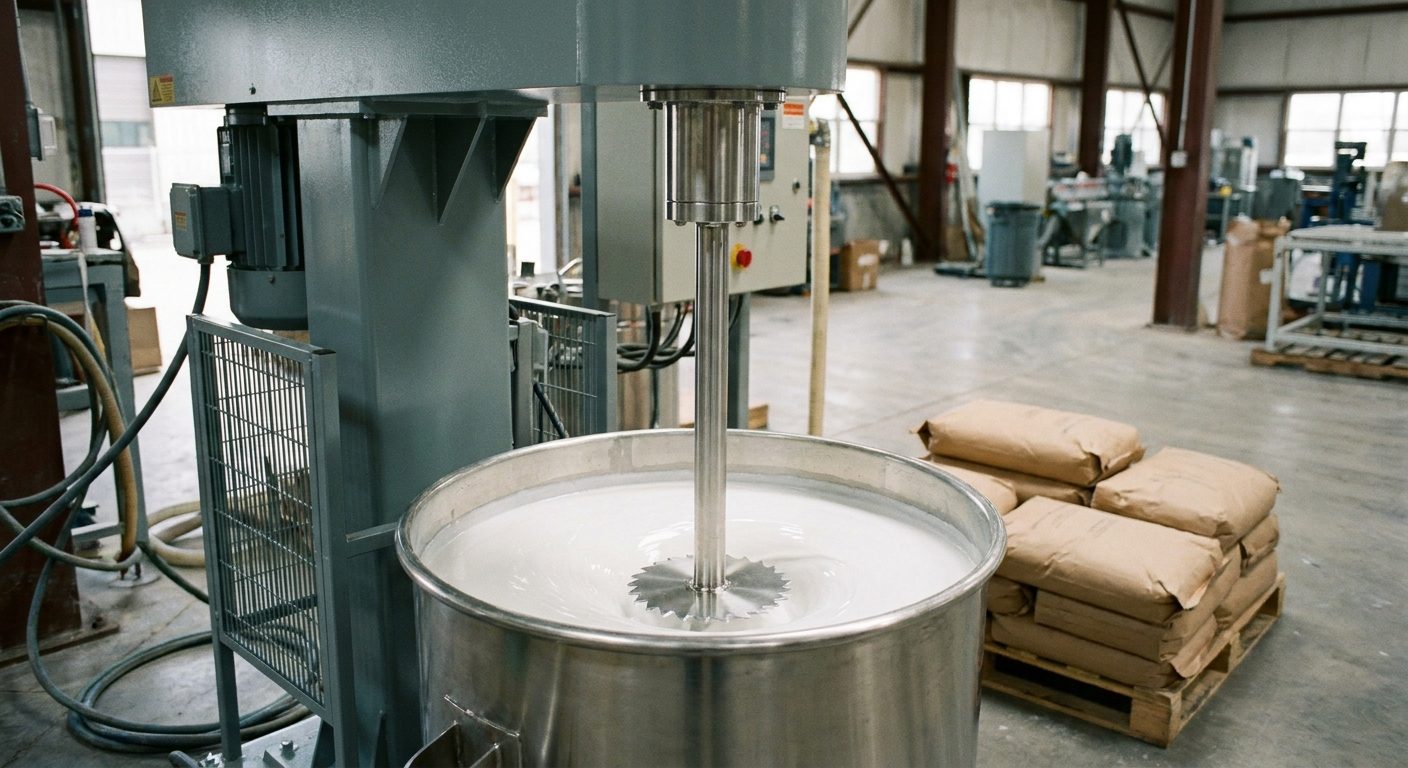
How a disperser works
Turning powder and liquid into one smooth batch
A high speed disperser spins a toothed disc blade on a vertical shaft inside the tank. The blade throws material outward at high velocity, and the batch rolls back down to the blade from the surface and the tank bottom, so every part of the batch passes through the blade zone again and again.
At the blade edge, fast-moving material meets slower material around it. That difference in speed tears clusters of particles apart and lets the liquid reach every surface. Run correctly, the surface of the batch turns over in a smooth rolling ring that operators call the doughnut.
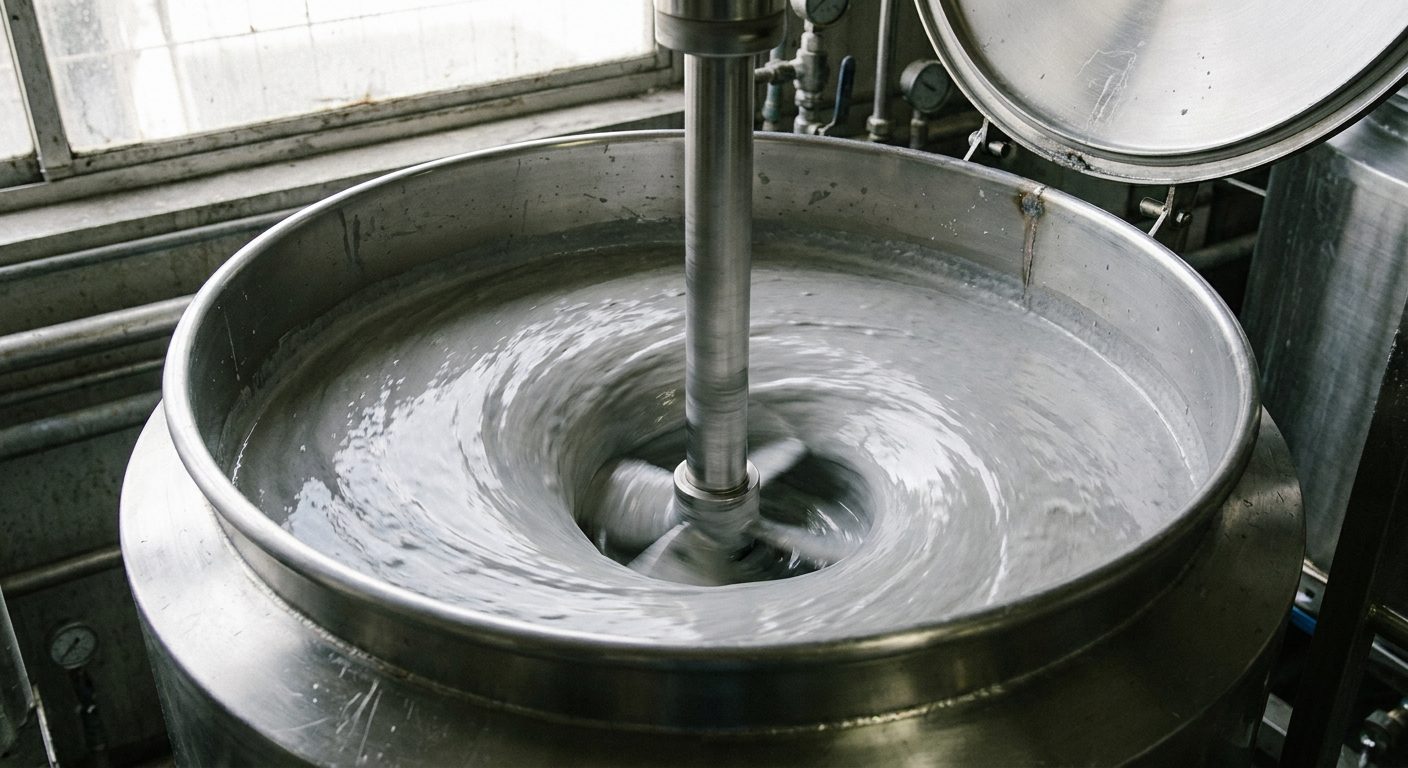
Stage 1
Wetting
Liquid replaces the air clinging to every particle surface. Powders that float or ball up on the batch surface have not wetted yet, and the disperser's rolling flow pulls them down into the liquid.
Stage 2
Deagglomeration
Clusters of particles break apart in the high-velocity zone at the blade edge, where the batch is torn between fast-moving and slower layers. Breaking up these clusters is the main job of a disperser.
Stage 3
Stabilization
Once apart, particles have to stay apart. That depends on the formulation, usually the dispersant and resin system, rather than on the machine, so a good dispersion needs suitable equipment and a suitable formula.
Disperser blade
A flat disc with teeth bent alternately up and down around its edge. The teeth throw material outward at high velocity and create the shear zone where agglomerates come apart.
Shaft and drive
A vertical shaft driven by an electric or air motor, usually through a variable speed drive so the operator can ramp the speed up as powders go in and the batch thickens.
Lift
A hydraulic, air, or manual lift raises the head clear of the tank for cleaning and tank changes and sets the blade at the right height in the batch.
Tank and clamp
A stationary tank, or a portable tank on casters locked under the head with a clamp, so the tank cannot spin or creep while the blade runs at speed.
Blades and tip speed
Blade types and tip speed
Disperser speed is discussed as tip speed, the speed of the blade's outer edge, because that is what the batch feels. A smaller blade has to turn faster to reach the same tip speed as a larger one.
Tip speed
ft/min = 3.1416 × blade diameter (in) × rpm ÷ 12
A commonly cited working range for dispersion is roughly 4,000 to 6,000 ft/min (about 20 to 30 m/s). The right figure depends on the product; confirm it with the manufacturer and your own trials.
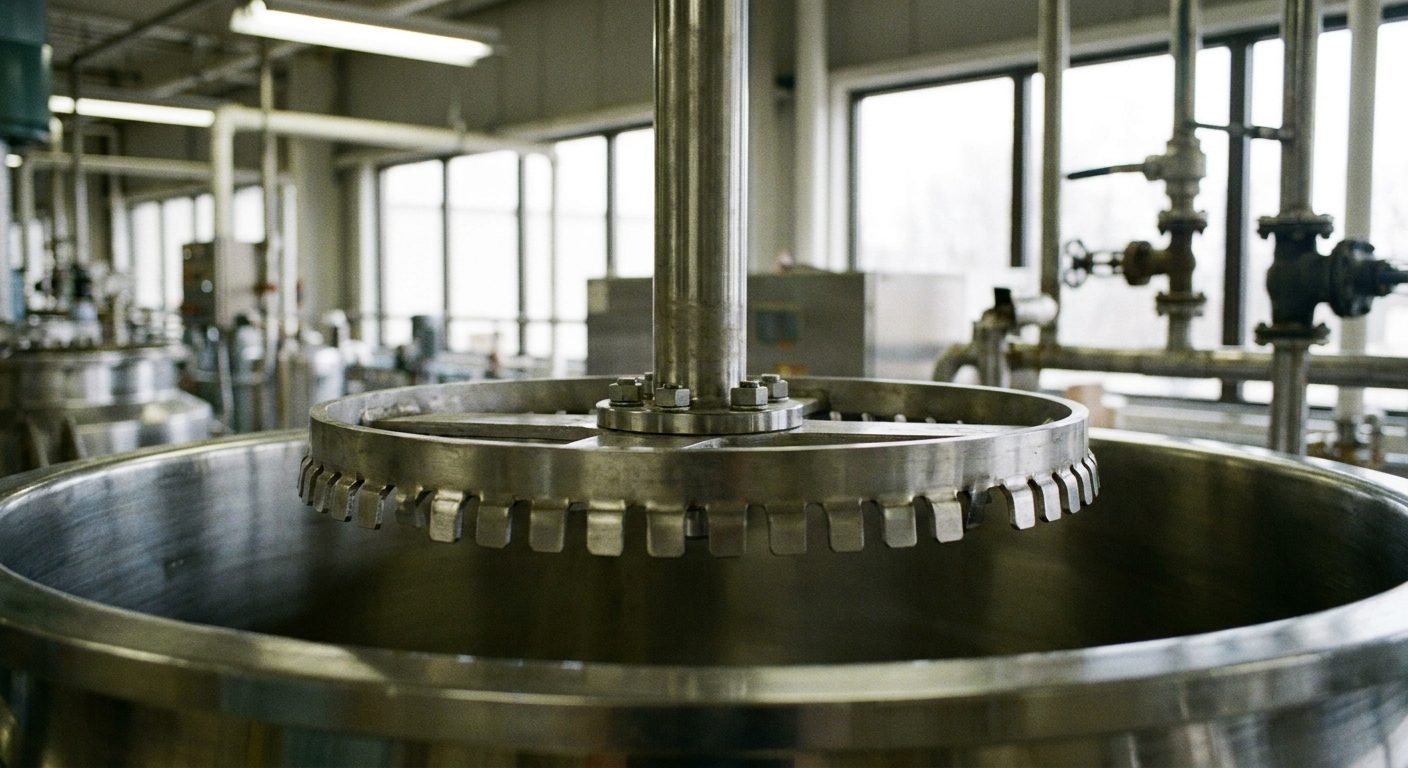
Standard saw-tooth blade
The general-purpose blade. It balances flow and shear and handles wetting and deagglomerating pigments and fillers in most coatings, inks, and adhesives.
High-shear blade
More, sharper teeth for more cutting action at the blade edge. Used where agglomerates are stubborn and the batch flows well enough to keep feeding the blade.
High-flow blade
Teeth shaped to pump more material through the blade zone. Used on heavier batches that need help turning over, or when wetting large powder additions quickly.
Polymer blade
A blade made from an engineering plastic instead of steel, used where metal contact is a concern for the product, at some cost in wear life.
Configurations
Single-shaft, multi-shaft, vacuum, and lab
Every configuration puts a disperser blade in the batch. They differ mainly in how they keep a thick batch moving and how they deal with air, heat and batch size.
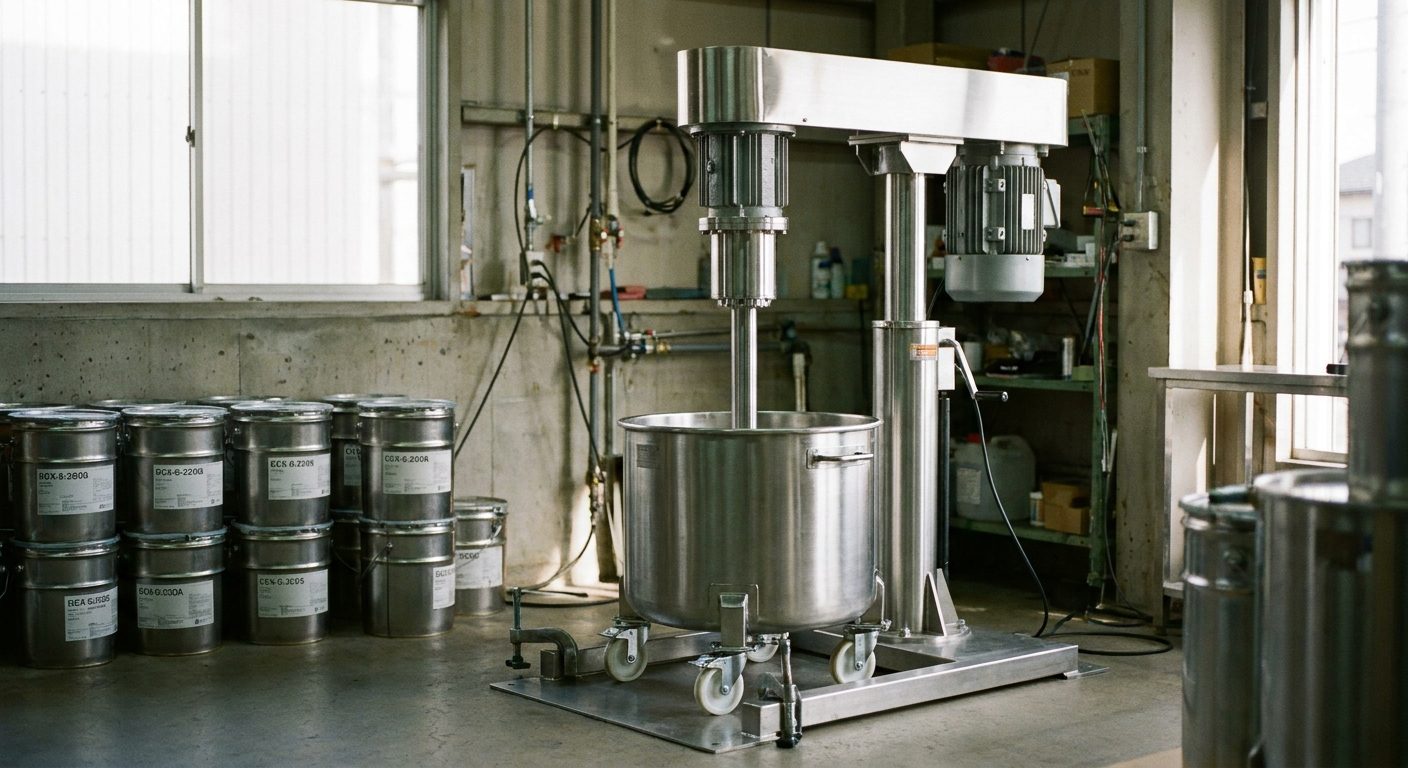
Single-shaft production dispersers
One disperser shaft on a lift column, set over a stationary tank or a portable tank clamped underneath. Paint, ink, and adhesive plants use this setup for batches that flow back to the blade on their own.
- Hydraulic or air lift to raise the head for tank changes and cleaning.
- Variable speed drive to ramp speed as powders go in and viscosity builds.
- Electric motors, explosion-proof motors, or air motors to suit the area classification.
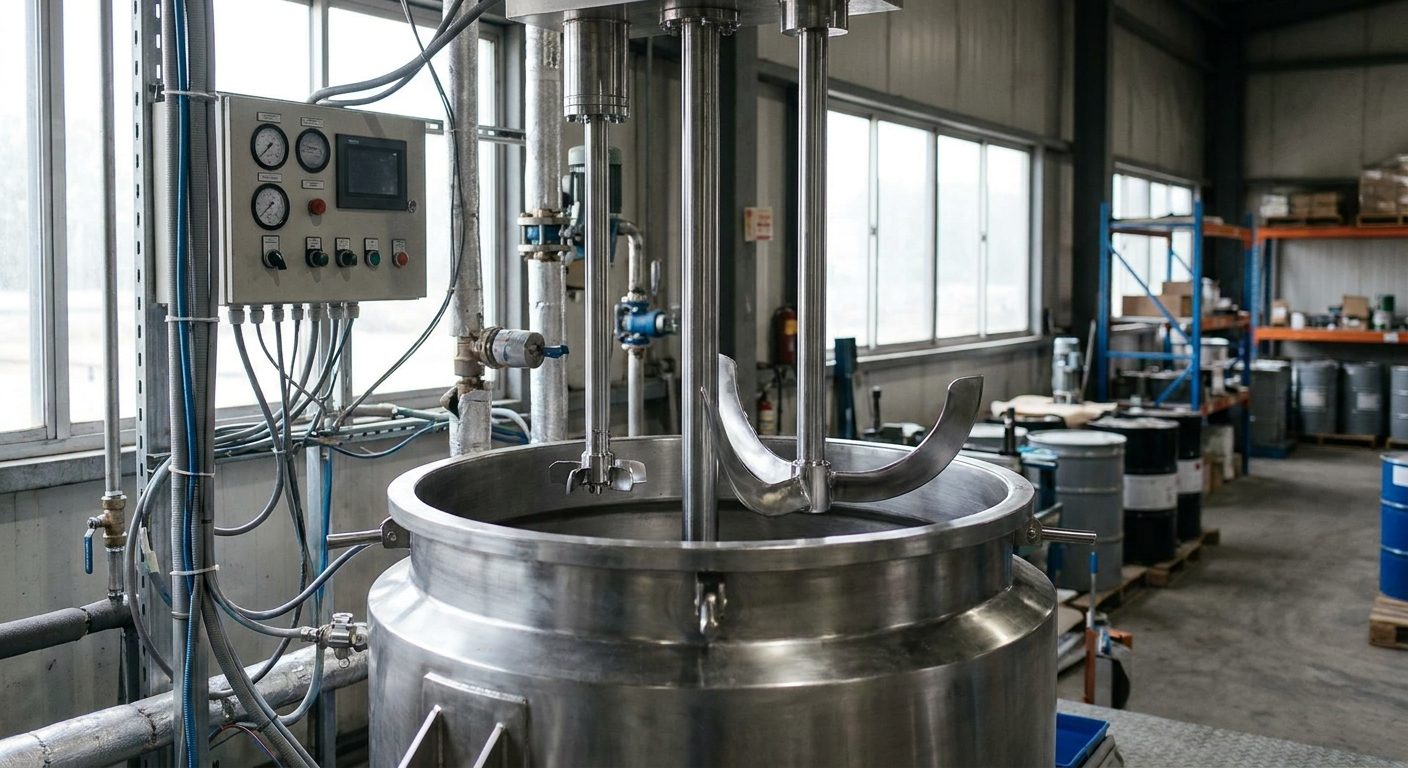
Dual- and multi-shaft mixers
A disperser shaft paired with a slow anchor or sweep agitator that scrapes the tank wall and keeps a thick batch moving into the blade. Plants move to this design when a single shaft leaves material sitting still at the wall.
- Handles heavier batches than a single shaft can turn over.
- Wall scraping helps heat transfer in jacketed vessels.
- Often built with vacuum capability to pull air out of the batch.
Lab and benchtop dispersers
Small dispersers for formulation work and quality control, run in cans and beakers. Used to develop a recipe and set the tip speed before a batch is scaled up.
Vacuum dispersers
Dispersers on a sealed vessel under vacuum, so entrained air comes out of the batch during mixing. Used for products where trapped air shows up as defects in the finished film or bead.
Tank-mounted and bridge dispersers
A disperser mounted on a bridge across a fixed tank or directly on the vessel, rather than on a floor lift. Common on larger stationary tanks in production lines.
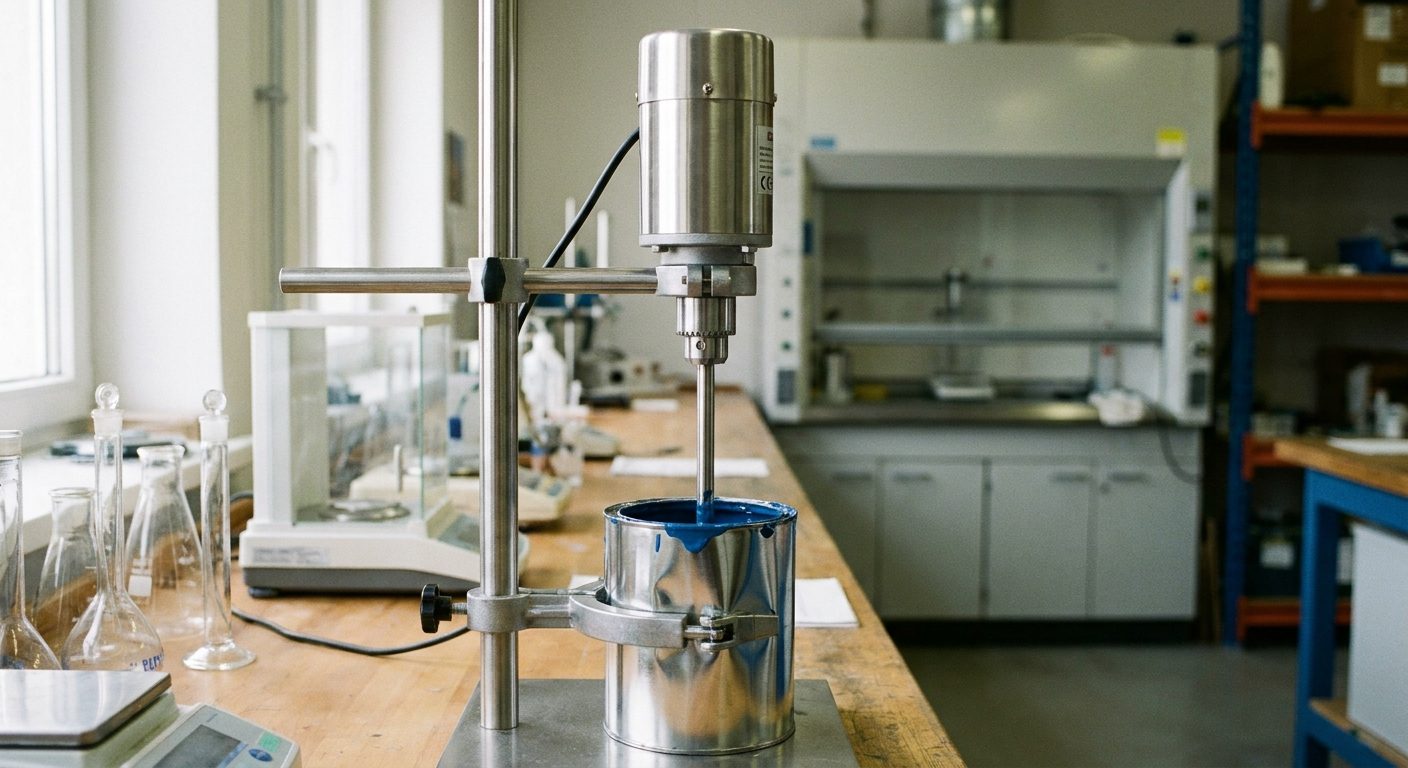
Scaling up from the lab
Formulators develop a recipe on a lab disperser, then carry it to a production machine. Keeping the tip speed and the tank proportions close between the two makes the production batch behave like the lab batch. Heat build-up and power per unit of batch volume still change with scale, so plan production trials.
Applications
Where high speed dispersers are used
When a dry powder has to become part of a liquid product without lumps or specks, a disperser is usually the first machine the batch sees.
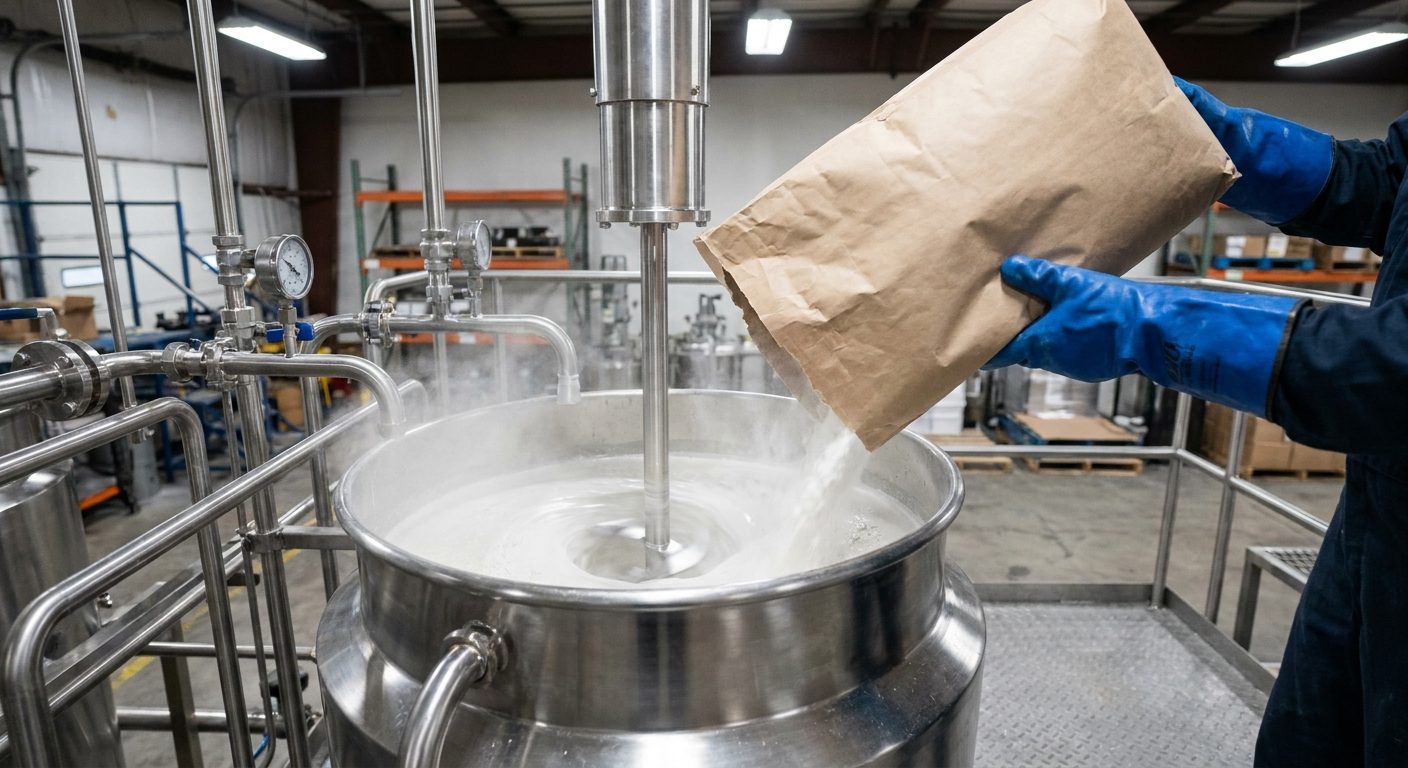
Paints and architectural coatings
Wetting titanium dioxide, extenders, and color pigments into the grind stage of water-based and solvent-based paints, then letting down the batch in the same tank.
Industrial and protective coatings
Dispersing pigments and fillers into higher-performance resin systems, where solvent-based batches often call for explosion-proof or air-driven equipment.
Printing inks
Making ink premixes and color concentrates, often as the millbase that feeds a media mill for the final grind.
Adhesives and sealants
Incorporating fillers, thickeners, and pigments into adhesive and sealant bases, where heavier batches often move to dual-shaft mixers.
Pigment and color concentrates
Producing tints and pigment dispersions with high pigment loading, where wetting large powder additions quickly is the main job.
Chemical slurries
Wetting and suspending powders in liquids for chemical, mineral, and specialty products that need a uniform, lump-free slurry.
Sizing and selection
What to settle before you request a quote
| Factor | What it decides |
|---|---|
| Batch size and tank | The batch volume and the tank diameter set the blade size and the horsepower. Confirm whether you need one stationary tank or several portable tanks on casters under one head. |
| Viscosity and solids | How thick the batch gets at its peak, and how much powder goes in, decide whether a single shaft will keep the batch turning over or a dual-shaft mixer is needed. |
| Tip speed | The blade diameter and the drive's speed range together set the available tip speed. Make sure the machine can reach the speed your process needs with the blade size the tank calls for. |
| Area classification | Solvent-based products are often made in hazardous (classified) locations, which decides between standard, explosion-proof, and air-driven motors and controls. |
| Lift and access | Hydraulic, air, or manual lift, the clearance needed to raise the blade fully out of the tallest tank, and the floor space for the lift column. |
| Heat and air | Heat-sensitive or air-sensitive products may need a jacketed tank for cooling, a vacuum vessel to remove entrained air, or both. |
Tank geometry rules of thumb
- Blade to tank diameter
- About 1 : 3
- Blade above tank bottom
- About 0.5 to 1 blade diameter
- Batch depth
- About 1 to 2 blade diameters
- Tip speed, commonly cited
- About 4,000 to 6,000 ft/min
Widely used starting points, not specifications. Products with unusual flow behavior need different proportions; have the manufacturer confirm them for your formulation.
Running a dispersion
A typical dispersion, step by step
- 1Charge the liquid portion first and start the blade at low speed.
- 2Add powders gradually into the vortex rather than dumping them on the surface, and raise the speed as the batch thickens.
- 3Run at working speed with the batch in a smooth doughnut pattern: a rolling surface, a small vortex at the center, and no splashing.
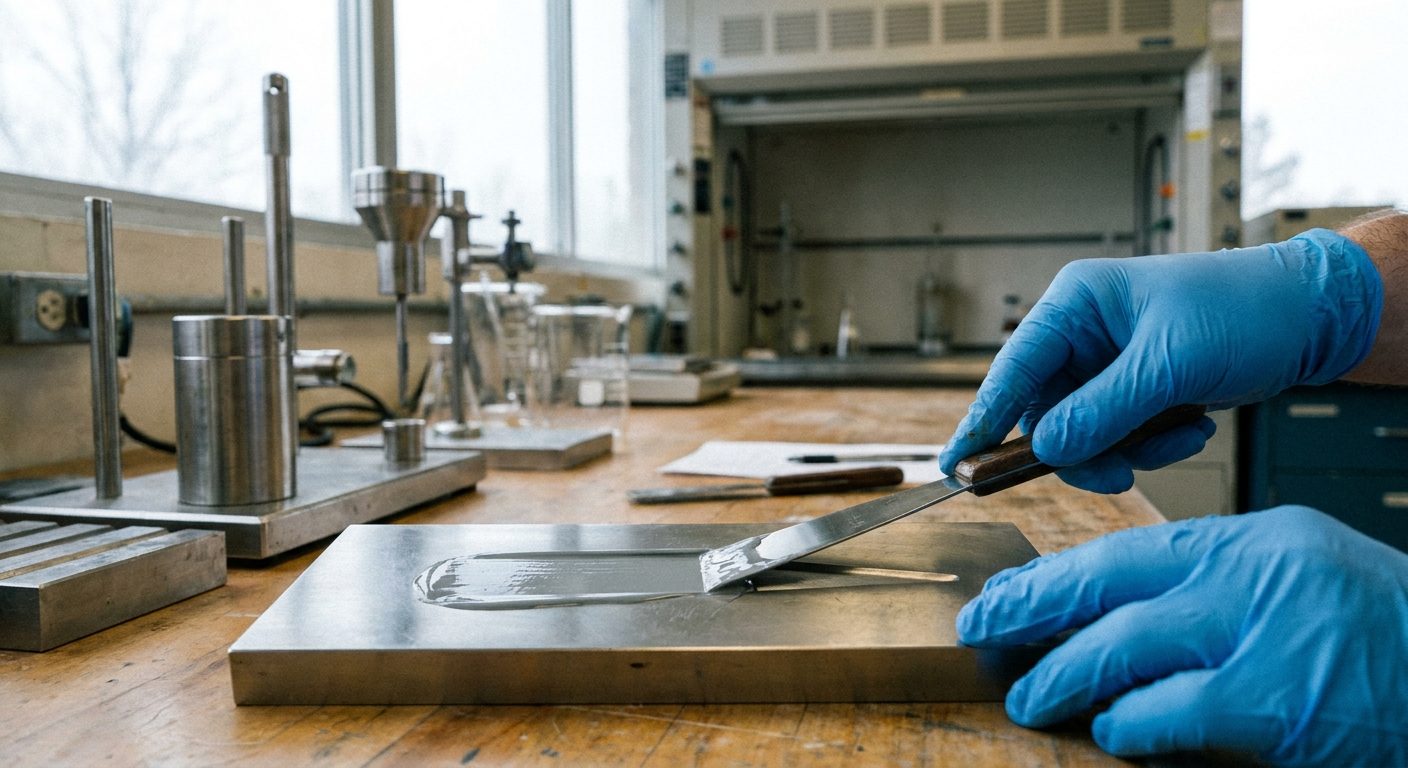
- 4Check the dispersion with a fineness-of-grind gauge and against the standard, not by the clock alone.
- 5Let down the batch at a lower speed once the grind is in specification.
Best practices
- Set the blade height and batch depth to suit the tank before the first powder goes in.
- Watch the batch as well as the speed setting. A deep vortex or splashing pulls in air, and a still surface at the wall means dead zones.
- Keep the tank clamped and the tank centered under the shaft so the blade runs true.
- Monitor batch temperature on long runs, and use a jacketed tank where the product is heat-sensitive.
- Inspect blades for worn or bent teeth; a worn blade gives up shear long before it looks damaged.
- Raise the blade clear and clean it promptly between batches so dried material does not throw it out of balance.
Checking the grind: coatings and ink makers commonly read fineness of grind on a Hegman-type gauge, drawing a sample down a tapered groove and reading where particles first appear. ASTM D1210 describes the method.
Information only. The guidance on this page is general and educational. It is not engineering, process or safety advice and does not replace the equipment manufacturer's instructions, your process requirements, applicable codes, or a qualified professional. Verify all information before relying on it. Read the full disclaimer.
FAQ
High speed disperser questions
What is a high speed disperser?
A high speed disperser is a mixer that turns a flat, toothed disc blade on a vertical shaft at high speed inside a tank. The blade pulls the batch into a rolling flow and the very high velocity at its edge tears powder clusters apart and wets them out in the liquid. In Europe the same machine is often called a dissolver, and the toothed blade is widely known as a Cowles-style or saw-tooth blade.
What does a disperser do to a powder?
Dispersing a powder into a liquid involves three things: wetting (replacing the air on the particle surfaces with liquid), deagglomeration (breaking clusters of particles apart), and stabilization (keeping them apart afterwards). A high speed disperser does the first two. Stabilization comes from the formulation, usually the dispersant and resin system, not from the machine. A disperser breaks up agglomerates; it does not grind hard primary particles finer, which is the job of a media mill.
How fast should the blade run?
Disperser speed is usually discussed as blade tip speed, the speed of the blade's outer edge, rather than rpm. A commonly cited working range for dispersion is roughly 4,000 to 6,000 feet per minute (about 20 to 30 meters per second). Tip speed in feet per minute equals pi times the blade diameter in inches times rpm, divided by 12, so a smaller blade has to turn faster to reach the same tip speed. The right speed depends on the product, so confirm it with the equipment manufacturer and your own trials.
How big should the blade be for my tank?
Widely used rules of thumb put the blade diameter at about one third of the tank diameter, the blade about one half to one blade diameter above the tank bottom, and the batch depth at about one to two blade diameters. These ratios give the batch room to roll over the blade without dead zones near the wall. Products with unusual flow behavior can need different proportions, so treat the ratios as a starting point.
What is the doughnut flow pattern?
When a disperser is set up and running correctly, the batch rolls toward the blade from the bottom and the top surface turns over smoothly toward the shaft, forming a rolling ring that operators call the doughnut, with a small vortex at the center. A deep vortex or splashing usually means the speed is too high for the batch, which pulls in air. A sluggish surface or material sitting still at the wall means the speed is too low or the batch is too thick for single-shaft mixing.
What viscosity can a single-shaft disperser handle?
Single-shaft dispersers work best on low to moderate viscosity batches that still flow back to the blade on their own. As viscosity climbs, material near the tank wall stops moving and the blade ends up working on a small pocket around itself. Dual-shaft and multi-shaft mixers solve this by adding a slow anchor or sweep agitator that keeps the whole batch turning over. The practical limit depends on the product's rheology, so ask the manufacturer to review your formulation.
Disperser or media mill: which do I need?
Use a high speed disperser to wet out powders and break up agglomerates. If your product needs a finer particle size than the disperser can reach, a media (bead) mill follows it. In many coatings and ink plants the disperser makes the premix, often called the millbase, that is then fed to the mill.
How is a disperser different from a rotor-stator mixer?
A rotor-stator mixer spins a rotor inside a closely fitted stator, so the shear happens in a narrow gap. It is often chosen for emulsions and fine droplet sizes. A high speed disperser uses an open blade and relies on bulk flow through the high-velocity zone at the blade edge, which suits wetting large amounts of powder into a batch. The two overlap, and the better choice depends on the product and the result you need.
How do I know when the dispersion is done?
Time alone is not a reliable signal. Coatings and ink makers usually check fineness of grind with a Hegman-type gauge, drawing a sample down a tapered groove and reading where particles first show (ASTM D1210 describes the method). Color strength, gloss, and viscosity checks against a standard are also common.
Do I need explosion-proof equipment for solvent-based products?
Often, yes. Solvent-based coatings, inks, and adhesives are frequently made in hazardous (classified) locations, and the disperser's motor, controls, and electrical fittings must be rated for the area classification, or an air-driven motor used instead. The classification is set by your facility and the authority having jurisdiction, so confirm it before specifying equipment.
How do I scale up from a lab disperser to production?
Keep the blade tip speed and the geometric ratios (blade to tank diameter, blade height, batch depth) as close as practical between the lab and production machines, and expect differences in heat build-up and power per unit of batch volume. Run lab trials on the actual formulation and have the manufacturer review the scale-up.
Why does the batch get hot during dispersion?
Almost all of the mechanical energy the blade puts into the batch ends up as heat. Long runs at high tip speed can raise the batch temperature significantly, which matters for heat-sensitive resins and solvents. Plants usually handle it with jacketed tanks for cooling, temperature monitoring, and limits on run time.
Request a quote
Get a high speed disperser quote
Whether you need a benchtop unit for the lab or a production disperser for a full tank, tell us the product, the batch size, and whether it is solvent or water based. We will get a quote back to you.
- Single-shaft, dual-shaft, vacuum, and lab dispersers
- Hydraulic, air, and manual lifts; standard, explosion-proof, and air motors
- Replacement blades sized to your tank and tip speed